Oxygen ("Octium") is a chemical element in the
periodic table that has the symbol O and atomic
number 8. The element is very common, found not only on Earth
but throughout the universe. Molecular oxygen (O2)
(often called free oxygen) on Earth is thermodynamically
unstable. Its initial appearance was due to the action of photosynthetic
anaerobes and its ubiquity in later epochs has been largely facilitated
by terrestrial plants, which release oxygen during photosynthesis.
|
|
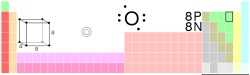
| General |
| Name, Symbol, Number |
Oxygen, O, 8 |
| Chemical series |
nonmetals |
| Group, Period, Block |
16 (VIA), 2 , p |
| Density, Hardness |
1.429 kg/m3 (273K), NA |
| Appearance |
colorless
|
| Atomic properties |
| Atomic weight |
15.9994 amu |
| Atomic radius (calc.) |
60 (48) pm |
| Covalent radius |
73 pm |
| van der Waals radius |
152 pm |
| Electron configuration |
[He]2s22p4 |
| e- 's per energy level |
2, 6 |
| Oxidation states (Oxide) |
-2,-1 (neutral) |
| Crystal structure |
cubic |
| Physical properties |
| State of matter |
gas (paramagnetic) |
| Melting point |
50.35 K (-368.77 °F) |
| Boiling point |
90.18 K (-297.08 °F) |
| Molar volume |
17.36 ×10⁻⁶ m3/mol |
| Heat of vaporization |
3.4099 kJ/mol |
| Heat of fusion |
0.22259 kJ/mol |
| Vapor pressure |
__ Pa at __ K |
| Speed of sound |
317.5 m/s at 293 K |
| Miscellaneous |
| Electronegativity |
3.44 (Pauling scale) |
| Specific heat capacity |
920 J/(kg*K) |
| Electrical conductivity |
ND 106/m ohm |
| Thermal conductivity |
0.02674 W/(m*K) |
| 1st ionization potential |
1313.9 kJ/mol |
| 2nd ionization potential |
3388.3 kJ/mol |
| 3rd ionization potential |
5300.5 kJ/mol |
| 4th ionization potential |
7469.2 kJ/mol |
| Most
stable isotopes |
| iso |
NA |
half-life |
DM |
DE MeV |
DP |
| 16O |
99.762% |
O is stable with 8 neutrons |
| 17O |
0.038% |
O is stable with 9 neutrons |
| 18O |
0.2% |
O is stable with 10 neutrons |
|
| SI
units & STP are used except where noted. |
Notable characteristics
At standard temperature and pressure, oxygen is found as a gas
consisting of two oxygen atoms, chemical formula O2.
This oxygen is an important component of air, produced by plants
during photosynthesis and is necessary for animals' respiration.
The word oxygen derives from two words in Greek, the
Greek oxus (acid) and geinomai (engender). (A misnomer,
as there are many acids which do not contain oxygen.)
Liquid oxygen and solid oxygen have a light blue color and both
are highly paramagnetic. Liquid oxygen is usually obtained by
the fractional distillation of liquid air.
Applications
Oxygen finds considerable use as an oxidizer, with only fluorine
having a higher electronegativity. Liquid oxygen finds use as
an oxidizer in rocket propulsion. Oxygen is essential to respiration,
so oxygen supplementation has found use in medicine. People who
climb mountains or fly in airplanes sometimes have supplemental
oxygen supplies (as air). Oxygen is used in welding, and in the
making of steel and methanol.
Oxygen, as a mild euphoric, has a history of recreational use
that extends into modern times. Oxygen bars can be seen at parties
to this day. In the 19th century, oxygen was often mixed with
nitrous oxide to promote a kind of analgesic effect.
History
Oxygen was discovered by the Swedish pharmacist Karl Wilhelm
Scheele in 1771, but this discovery was not immediately recognized,
and the independent discovery by Joseph Priestley on August 1st
1774 was more widely known. It was named by Antoine Laurent Lavoisier
in 1774.
Occurrence
Oxygen is the most abundant element in the Earth's crust, estimated
to comprise 46.7% of it. Oxygen comprises about 87% of the oceans
(as H2O, water) and 20% of the atmosphere of Earth
(as O2, molecular oxygen, or O3, ozone).
Oxygen compounds, particularly metal oxides, silicates (SiO44-)
and carbonates (CO32-), are commonly found
in rocks and soil. Frozen water is a common solid on the outer
planets and comets. The ice caps of Mars are made of frozen carbon
dioxide. Oxygen compounds are found throughout the universeand
the spectrum of oxygen is often seen in stars.
Compounds
Due to its electronegativity, oxygen forms chemical bonds with
almost all other elements (which is the origin of the original
definition of oxidation). The only elements to escape the possibility
of oxidation are a few of the noble gases. The most famous of
these oxides is of course hydrogen oxide, or water (H2O).
Other well known examples include compounds of carbon and oxygen,
such as carbon dioxide (CO2), alcohols (R-OH), aldehydes,
(R-CHO), and carboxylic acids (R-COOH). Oxygenated radicals such
as chlorates (ClO3-), perchlorates (ClO4-),
chromates (CrO42-), dichromates (Cr2O72-),
permanganates (MnO4-), and nitrates (NO3-)are
strong oxidizing agents in and of themselves. Many metals such
as Iron bond with oxygen atoms, iron (III) oxide (Fe2O3).
Ozone (O3) is formed by electrostatic discharge in
the presence of molecular oxygen. A double oxygen molecule (O2)2
is known, found as a minor component of liquid oxygen. Epoxides
are ethers in which the oxygen atom is part of a ring of three
atoms.
Isotopes
Oxygen has three stable isotopes and ten known radioactive
isotopes. The radioisotopes all have half lives of less than
three minutes.
Precautions
Oxygen can be toxic at elevated partial pressures.
Certain derivatives of oxygen, such as ozone (O3),
hydrogen peroxide, hydroxyl radicals and superoxide, are also
highly toxic. The body has developed mechanisms to protect against
these toxic species. For instance, the naturally-occurring glutathione
can act as an antioxidant, as can bilirubin which is normally
a breakdown product of hemoglobin. Highly concentrated sources
of oxygen promote rapid combustion and therefore are fire and
explosion hazards in the presence of fuels. This is true as well
of compounds of oxygen such as chlorates, perchlorates, dichromates,
etc. Compounds with a high oxidative potential can often cause
chemical burns.
The fire that killed the Apollo 1 crew on a test launchpad spread
so rapidly because the pure oxygen atmosphere was at normal atmospheric
pressure instead of the one third pressure that would be used
during an actual launch. (see partial pressure)
See also
Reference
External links