Quercetin Molecule
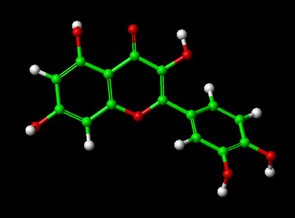
Quercetin Molecule
Quercetin is a flavonoid and, to be more specific, a flavonol.
Chemical structure -- molecular mass 302.236 g/mol -- molecular formula C15H10O7
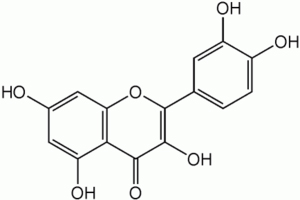
It is the aglycone form of a number of other flavonoid glycosides, such as rutin and quercitrin, found in citrus fruit & onions. Quercetin forms the glycosides quercitrin and rutin together with rhamnose and rutinose, respectively.
Medicinal properties
Quercetin is found to be the most active of the flavonoids in studies and many medicinal plants owe much of their activity to their high quercetin content. Quercetin has demonstrated significant anti-inflammatory activity because of direct inhibition of several initial processes of inflammation. For example, it inhibits both the manufacture and release of histamine and other allergic/inflammatory mediators. In addition, it exerts potent antioxidant activity and vitamin C-sparing action. Quercetin also shows anti-tumour properties. A study in the British Journal of Cancer showed that, when treated with a combination of quercetin and ultrasound at 20 kHz for 1 minute duration, skin and prostate cancers show a 90% mortality within 48 hours with no visible mortality of normal cells.[2] Note that ultrasound also promotes topical absorption by up to 1,000 times making the use of topical quercetin and ultrasound wands an interesting proposition.
Recent studies have supported that quercetin can help men with chronic prostatitis, and both men and women with interstitial cystitis, possibly because of its action as a mast cell inhibitor.
Quercetin may have positive effects in combating or helping to prevent cancer, prostatitis, heart disease, cataracts, allergies/inflammations, and respiratory diseases such as bronchitis and asthma. It also has antidepressant properties.
What Foods are rich in Quercetin
Foods rich in quercetin include capers (1800mg/kg)_ref-3-[4], lovage (1700mg/kg), apples (440mg/kg), tea (Camellia sinensis), onions (higher concentrations of quercetin occur in the outermost rings[5]), red grapes, citrus fruits, broccoli and other leafy green vegetables, cherries, and a number of berries including raspberry, bog whortleberry (158 mg/kg, fresh weight), lingonberry (cultivated 74mg/kg, wild 146 mg/kg), cranberry (cultivated 83 mg/kg, wild 121 mg/kg), chokeberry (89 mg/kg), sweet rowan (85 mg/kg), rowanberry (63 mg/kg), sea buckthorn berry (62 mg/kg), crowberry (cultivated 53mg/kg, wild 56 mg/kg),[6] and the fruit of the prickly pear cactus. A recent study found that organically grown tomatoes had 79% more quercetin than "conventionally grown". A study by the University of Queensland, Australia, has also indicated the presence of quercetin in varieties of honey, including honey derived from eucalyptus and tea tree flowers.
Dru/g interactions
Quercetin is contraindicated with antibiotics; it may interact with fluoroquinolones (a type of medicinal antibiotic), as quercetin competitively binds to bacterial DNA gyrase. Whether this inhibits or enhances the effect of fluoroquinolones is not entirely clear.
Quercetin is also a potent inhibitor of CYP3A4, an enzyme that breaks down most drugs in the body.[11] As such, quercetin would be expected to increase serum levels, and therefore effects, of drugs metabolized by this enzyme.
Cancer
Quercetin, a natural existing polyphenol compound, has shown anticancer capacity for liver, breast, nasopharyngeal and prostate carcinoma but has not been clinically approved yet. Quercetin induces apoptosis and inhibits migration. We are the first to show that quercetin displays potent inhibition on bladder cancer cells via activation of AMPK pathway. see: Quercetin induces bladder cancer cells apoptosis by activation of AMPK signaling pathway
The research team concluded that "in order to have a maximum anticancer effect, green tea or green tea extract should be used together with quercetin." See: Quercetin boosts green tea antioxidant capacity two to fourfold to fight cancer development
A study suggests that quercetin could inhibit cell proliferation and colony formation of human bladder cancer cells by inducing DNA damage and that quercetin may be an effective chemopreventive and chemotherapeutic agent for papillary urothelial bladder cancer after transurethral resection. see: Chemotherapeutic potential of quercetin on human bladder cancer cells.
"... Apart from antioxidant activity, Qu also exerts a direct, pro-apoptotic effect in tumor cells, and can indeed block the growth of several human cancer cell lines at different phases of the cell cycle. Both these effects have been documented in a wide variety of cellular models as well as in animal models..." see: Quercetin and Cancer Chemoprevention
References
- BBC Onions 'cut heart disease risk' 4 November 2007
- (2005) "Induction of cancer-specific cytotoxicity towards human prostate and skin cells using quercetin and ultrasound". British Journal of Cancer 92 (3): 499-502. doi:10.1038/sj.bjc.6602364. Retrieved on 2007-5-19.
- Shoskes, DA et al (1999). "Quercetin in men with category III chronic prostatitis: a preliminary prospective, double-blind, placebo-controlled trial.". Urology. 54 (6).
- USDA Database for the Flavonoid Content of Selected Foods
- Crystal Smith, Kevin A. Lombard, Ellen B. Peffley, Weixin Liu (2003). "Genetic Analysis of Quercetin in Onion (Allium cepa L.) Lady Raider". The Texas Journal of Agriculture and Natural Resource 16: 24-28. Agriculture Consortium of Texas.
- Sari H. Häkkinen et al (1999). "Content of the Flavonols Quercetin, Myricetin, and Kaempferol in 25 Edible Berries". Journal of Agricultural and Food Chemistry 47 (6): 2274 -2279. doi:10.1021/jf9811065. PMID 10794622. Retrieved on 2007-06-13.
- A. E. Mitchell, Y. J. Hong, E. Koh, D. M. Barrett, D. E. Bryant, R. F. Denison and S. Kaffka (2007). "Ten-Year Comparison of the Influence of Organic and Conventional Crop Management Practices on the Content of Flavonoids in Tomatoes". J. Agric. Food Chem. 55 (15): 6154-6159. doi:10.1021/jf070344+.
- Honey Research Unit
- honey fingerprinting
- Hilliard JJ, Krause HM, Bernstein JI, Fernandez JA, Nguyen V, Ohemeng KA, Barrett JF. 'A comparison of active site binding of 4-quinolones and novel flavone gyrase inhibitors to DNA gyrase. Adv Exp Med Biol. 1995;390:59-69. PMID 8718602.
- Su-Lan Hsiu; Yu-Chi Hou; Yao-Horng Wang; Chih-Wan Tsao; Sheng-Fang Sue; and Pei-Dawn L. Chao (6 December 2002). "Quercetin significantly decreased cyclosporin oral bioavailability in pigs and rats". Life Sciences 72 (3): 227-235. doi:10.1016/S0024-3205(02)02235-X.
External References
- UMM Quercetin Info Page (University of Maryland Medical Center Website)
- Eyes right for a cup of tea UK Institute of Food Research article on how quercetin can help prevent cataracts.
- Plant foods for health protection article by the Institute of Food Research (Norwich, United Kingdom)
- Scanning Electron Micrograph image of quercetin crystals derived from onion
- Possible Interactions with: Quercetin Quercetin might enhance the effects of two chemotherapy medications
- Quercetin Info from the Cedars-Sinai Medical Center, Los Angeles.
- "Genetic Analysis of Quercetin in Onion (Allium cepa L.)" article from The Texas Journal of Agriculture and Natural Resource 16:24-28 (2003).
- "Ten-Year Comparison of the Influence of Organic and Conventional Crop Management Practices on the Content of Flavonoids in Tomatoes" article at American Chemical Society website (originally published 23rd June 2007).
- "An apple a day could help protect against brain-cell damage" article at Cornell University website