Acetylcholine Molecule
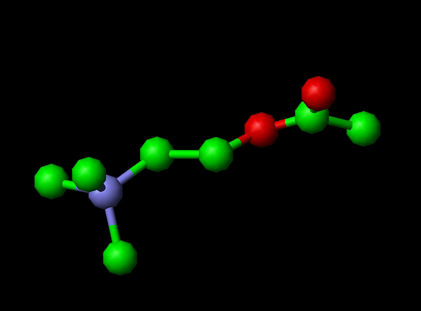
Acetylcholine Ball and Stick Model
To View the Acetylcholine Molecule in 3D --->>in 3D with Jsmol
The chemical compound acetylcholine has the chemical formula C7H16NO2 and molecular mass 146.21 g/mol. It is (often abbreviated ACh) is a neurotransmitter in both the peripheral nervous system (PNS) and central nervous system (CNS) in many organisms including humans. Acetylcholine is one of many neurotransmitters in the autonomic nervous system (ANS) and the only neurotransmitter used in the somatic nervous system. It is also the neurotransmitter in all autonomic ganglia.
Function
Acetylcholine has functions both in the peripheral nervous system (PNS) and in the central nervous system (CNS) as a neuromodulator.In the PNS, acetylcholine activates muscles, and is a major neurotransmitter in the autonomic nervous system. In the CNS, acetylcholine and the associated neurons form a neurotransmitter system, the cholinergic system, which tends to cause excitatory actions.
In Peripheral Nervous System
In the peripheral nervous system, acetylcholine activates muscles, and is a major neurotransmitter in the autonomic nervous system.When acetylcholine binds to acetylcholine receptors on skeletal muscle fibers, it opens ligand gated sodium channels in the cell membrane. Sodium ions then enter the muscle cell, stimulating muscle contraction. Acetylcholine, while inducing contraction of skeletal muscles, instead induces decreased contraction in cardiac muscle fibers. This distinction is attributed to differences in receptor structure between skeletal and cardiac fibers.
In the autonomic nervous system, acetylcholine is released in the following sites: all pre- and post-ganglionic parasympathetic neurons; all preganglionic sympathetic neurons; preganglionic sympathetic fibers to suprarenal medulla, the modified sympathetic ganglion; on stimulation by acetylcholine, the suprarenal medulla releases adrenaline and noradrenaline and some postganglionic sympathetic fibers -- sudomotor neurons to sweat glands.
In Central Nervous System
In the central nervous system, ACh has a variety of effects as a neuromodulator, e.g., for plasticity and excitability. Other effects are arousal and reward.
Plasticity
ACh is involved with synaptic plasticity, specifically in learning and short-term memory. Acetylcholine has been shown to enhance the amplitude of synaptic potentials following long-term potentiation in many regions, including the dentate gyrus, CA1, piriform cortex, and neocortex. This effect most likely occurs either through enhancing currents through NMDA receptors or indirectly by suppressing adaptation. The suppression of adaptation has been shown in brain slices of regions CA1, cingulate cortex, and piriform cortex, as well as in vivo in cat somatosensory and motor cortex by decreasing the conductance of voltage-dependent M currents and Ca2+-dependent K+ currents.
Excitability
Acetylcholine also has other effects on excitability of neurons. Its presence causes a slow depolarization by blocking a tonically-active K+ current, which increases neuronal excitability. It appears to be a paradox, however, that ACh increases spiking activity in inhibitory interneurons while decreasing strength of synaptic transmission from those cells. This decrease in synaptic transmission also occurs selectively at some excitatory cells: For instance, it has an effect on intrinsic and associational fibers in layer Ib of piriform cortex, but has no effect on afferent fibers in layer Ia. Similar laminar selectivity has been shown in dentate gyrus and region CA1 of the hippocampus. One theory to explain this paradox interprets acetylcholine neuromodulation in the neocortex as modulating the estimate of expected uncertainty, acting counter to norepinephrine (NE) signals for unexpected uncertainty. Both would then decrease synaptic transition strength, but ACh would then be needed to counter the effects of NE in learning, a signal understood to be 'noisy'.
Receptors
There are two main classes of acetylcholine receptor (AChR), nicotinic acetylcholine receptors (nAChR) and muscarinic acetylcholine receptors (mAChR). They are named for the ligands used to activate the receptors.
Nicotinic
Nicotinic AChRs are ionotropic receptors permeable to sodium, potassium, and chloride ions. They are stimulated by nicotine and acetylcholine. They are of two main types, muscle type and neuronal type. The former can be selectively blocked by curare and the latter by hexamethonium. The main location of nicotinic AChRs is on muscle end plates, autonomic ganglia (both sympathetic and parasympathetic), and in the CNS.
Muscarinic
Muscarinic receptors are metabotropic, and affect neurons over a longer time frame. They are stimulated by muscarine and acetylcholine, and blocked by atropine. Muscarinic receptors are found in both the central nervous system and the peripheral nervous system, in heart, lungs, upper GI tract, and sweat glands. Extracts from the plant Deadly nightshade included this compound (atropine), and the blocking of the muscarinic AChRs increases pupil size as used for attractiveness in many European cultures in the past. Now, ACh is sometimes used during cataract surgery to produce rapid constriction of the pupil. It must be administered intraocularly because corneal cholinesterase metabolizes topically-administered ACh before it can diffuse into the eye. It is sold by the trade name Miochol-E (CIBA Vision). Similar drugs are used to induce mydriasis (dilation of the pupil) in cardiopulmonary resuscitation and many other situations.
Readings and References
- Brenner, G. M. and Stevens, C. W. (2006). Pharmacology (2nd ed.). Philadelphia, PA: W.B. Saunders Company (Elsevier).\
- Canadian Pharmacists Association (2000). Compendium of Pharmaceuticals and Specialties (25th ed.). Toronto, ON: Webcom.
- Carlson, NR (2001). Physiology of Behavior (7th ed.). Needham Heights, MA: Allyn and Bacon.
- Gershon, Michael D. (1998). The Second Brain. New York, NY: HarperCollins.
- Hasselmo, ME. "Neuromodulation and cortical function: Modeling the physiological basis of behavior." Behavioral Brain Research. 1995 Feb; 67(1):1-27. PMID 7748496
- Yu, AJ & Dayan, P. "Uncertainty, neuromodulation, and attention." Neuron. 2005 May 19; 46(4):681-92. PMID 15944135