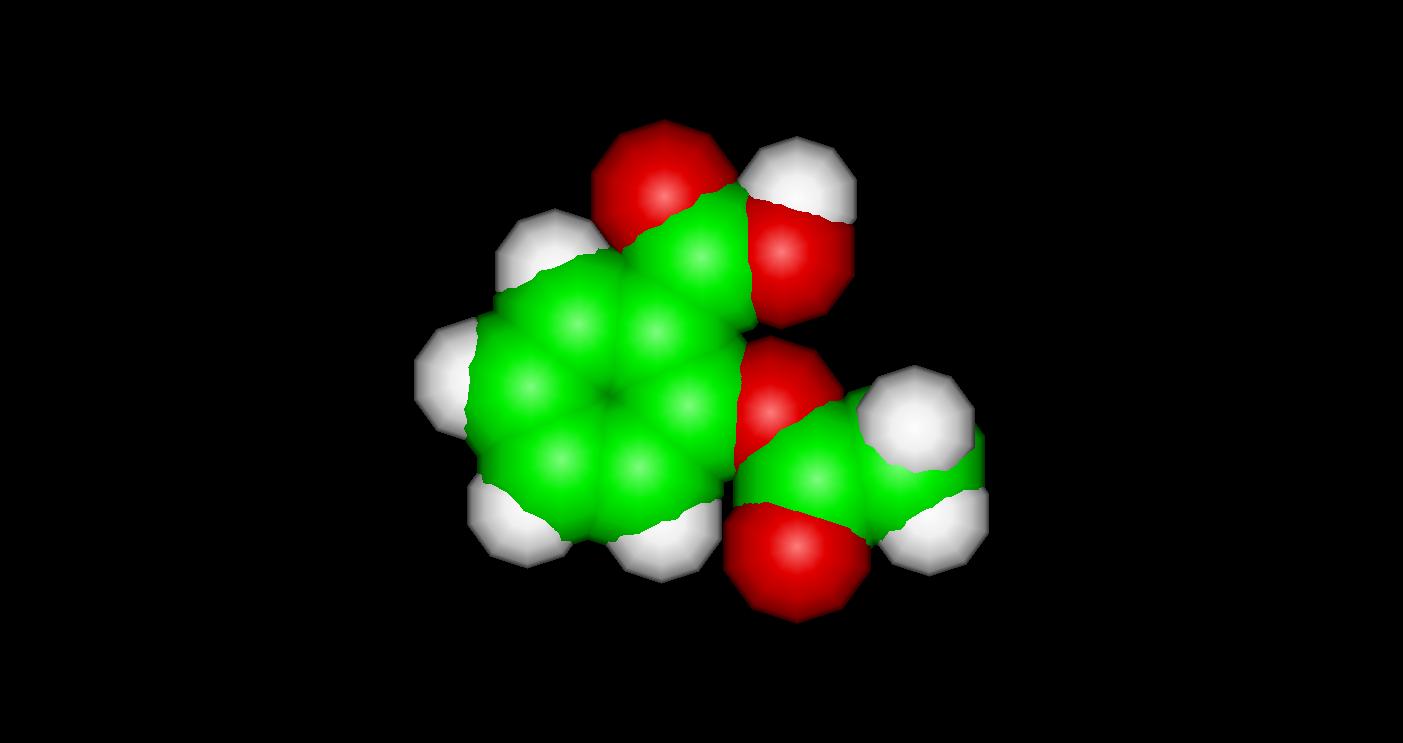
Aspirin is a brand name coined by the Bayer company of Germany for acetylsalicylic acid, part of the family of salicylates, often used as an analgesic, antipyretic, and anti-inflammatory. Aspirin is a non-steroidal anti-inflammatory drugs (NSAIDs) (see also: ibuprofen, tylenol, naproxen, vioxx, celebrex, and bextra.
To View the Aspirin Molecule --->>in 3D with Jsmol
At one time aspirin was commonly used to control fever and pain due to flu or the common cold. However because there appears to be a connection between aspirin and Reye's syndrome, aspirin is no longer used to control flu-like symptoms. Low-dose long-term aspirin irreversibly blocks formation of thromboxane A2 in platelets, producing an inhibitory affect on platelet aggregation, i.e. blood thinning property, making it useful for reducing the incidence of heart attacks. Aspirin produced for this purpose often comes in 75 mg dispersible tablets. Its primary undesirable side effects, especially in stronger doses, are gastrointestinal distress (including stomach bleeding) and tinnitus. Another side effect, due to is anticoagulant properties, is increased bleeding in menstruating women. Aspirin was the first discovered member of the class of drugs known as non-steroidal anti-inflammatory drugs (NSAIDs), not all of which are salicylates, though they all have similar effects and a similar action mechanism. There is evidence that salicylates in past ages were much more common in human diets than they are now. Salicylates are produced by fruit as a defence mechanism: inducing damaged and diseased cells to commit suicide. Modern man's predilection for fruit and vegetables in a pristine condition - with shoppers often rejecting fruit with bumps of bruises - means that we eat less salicylates than in the past. A study has shown that organic vegetable soups contain nearly six times as much salicylate as non-organic equivalents (European Journal of Nutrition, vol. 40 p 289). There are moves to have aspirin declared a vitamin, vitamin S, rather than a drug, though more research is needed to establish whether our diets are salicylate-deficient, resulting in higher levels of heart disease, cancer and Alzheimer's disease, than would be the case if everyone routinely took salicyalte supplements.
Hippocrates, a Greek for whom the Hippocratic Oath is named, wrote in the 5th century BC about a bitter powder extracted from willow bark that could ease aches and pains and reduce fevers. This remedy is also mentioned in texts from ancient Sumeria, Egypt and Assyria. Native American Indians used it for headaches, fever, sore muscles, rheumatism, and chills. The Reverend Edmund Stone, a vicar from Chipping Norton in Oxfordshire England, noted in 1763 that the bark of the willow was effective in reducing a fever, but his reasoning for that was very much in error.
The active extract of the bark, called salicin, after the Latin name for the white willow (Salix alba), was isolated to its crystaline form in 1828 by Henri Leroux, a French pharmacist, and Raffaele Piria, an Italian chemist, who then succeeded in separating out the acid in its pure state. Salicin is highly acidic when in a saturated solution with water (pH = 2.4), and is called salicylic acid for that reason. Salicylic acid's systematic name is 2-hydroxybenzoic acid.
This chemical was also isolated from meadowsweet flowers (Latin name spiraea) by German researchers in 1839. While somewhat effective, it also caused digestive problems such as irritated stomach and diarrhea. It can even cause death in high doses. In 1897 Felix Hoffmann, a chemist working for Friedrich Bayer & Co. in Germany, derivatized one of the hydroxyl functional groups in salicylic acid with an acetyl group (forming the acetyl ester) which greatly reduced the negative effects. The new product, named a- (for the acetyl group) -spir- (for the flower) -in (a common ending for drugs at the time), had fewer side effects and was more effective than salicin or salicylic acid. This was the first synthetic drug, not a copy of something that existed in nature, and the start of the pharmaceuticals industry. Bayer registered aspirin as a trademark on March 6, 1899.
However, the German company lost the right to use the trademark in many countries as the Allies seized and resold its foreign assets after World War I. In the United States, the right to use "Aspirin" there (along with all other Bayer trademarks) was purchased from the U.S. government by Sterling Inc in 1918. Even before the patent went into the public domain in 1917, Bayer had been unable to stop competitors from copying the formula and using the name elsewhere, and so with a flooded market, the public was unable to recognize "Aspirin" as coming from only one manufacturer. Sterling was subsquently unable to prevent "Aspirin" from being ruled a generic mark (and therefore unprotected) in a U.S. federal court in 1921. Other countries (such as Canada) still consider "Aspirin" a protected trademark.
How it works
In a piece of research for which he was awarded both a Nobel prize and a knighthood, John Vane, who was then employed by the Royal College of Surgeons in London, showed in 1971 that aspirin suppresses the production of local hormones known as prostaglandins. Cyclooxygenase, an enzyme which participates in the production of prostaglandins and thromboxanes, is irreversibly inactivated when aspirin attaches to it.
Prostaglandins are local hormones (paracrine) produced in the body and have diverse effects in the body, including but not limited to transmission of pain information to the brain, modulation of the hypothalamic thermostat and inflammation. Additionally thromboxanes are responsible for the aggregation of platelets that form blood clots. Heart attacks are primarily caused by blood clots, and their reduction with the introduction of small amounts of aspirin has been seen to be an effective medical intervention. The side effect of this is that the ability of the blood in general to clot is reduced, and excessive bleeding may result from the use of aspirin.
More recent work by M.G. Santoro has demonstrated that there are several types of prostaglandins. Those, such as the A, E and J12 type induce cell protective proteins, especially HSP, which aspirin blocks in addition to the prostoglandins associated with inflamation. In some auto-immune diseases, these other prostiglandins are excessively produced. The concept of cox 1 and cox 2 blockers was an attempt to block only the inflamitory causing prostaglandins. Recent work on other intra-cellular proteins have found other inflamitory causing substances not blocked by aspirn, such as fKb protein. The door Dr. Vane opened is proving to be a gateway to a still hardly understoon mircoworld.