Lutein/Zeaxanthin Molecule
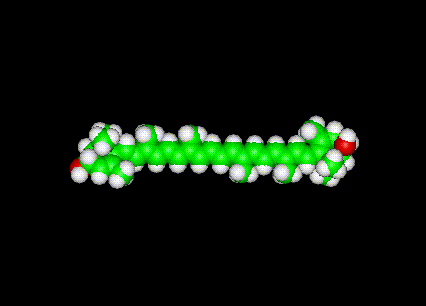
Image: Lutein/Zeaxanthin Molecule- Ball and Stick Model
To View the Lutein/Zeaxanthin Molecule in 3D --->> with Jsmol
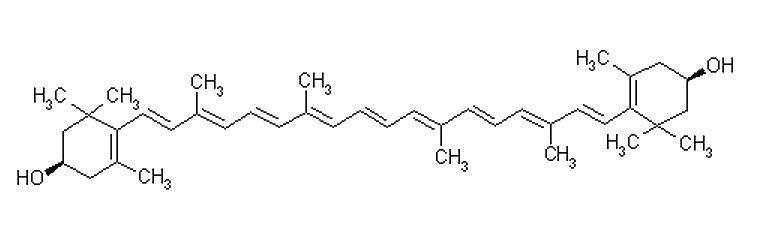
Lutein and zeaxanthin belong to the class of carotenoids known as xanthophylls and both contain hydroxyl groups. This makes them more polar than carotenoids, such as beta-carotene and lycopene, which do not contain oxygen. Although lutein and zeaxanthin have identical chemical formulas and are isomers, they are not stereoisomers. They are both polyisoprenoids containing 40 carbon atoms and cyclic structures at each end of their conjugated chains. The main difference between them is in the location of a double bond in one of the end rings giving lutein three chiral centers as opposed to two in zeaxanthin (see structure below).
Carotene plays a crucial role as a photosynthetic pigment, important for photosynthesis. . It does not actively contribute in photosynthesis, but instead it transmits the energy it absorbs to chlorophyll and also plays a protective role for chlorophyll being a powerful antioxidant that protects organic molecules from being destroyed by oxidation.
Carotene is the dimer of vitamin A and comes in two forms alpha and Beta-carotene. Both types can be stored in the liver, and unlike vitamin A, excess carotene is non-toxic and can also be converted to vitamin A as needed.
 Lutein and zeaxanthin are phytochemicals found most often in leafy green vegetables, but also in other fruits and vegetables. Chicken egg yolks are a rich food source of lutein and zeaxanthin; he average amount of lutein in chicken egg yolk is approximately 290 micrograms per yolk, and the average amount of zeaxanthin, approximately 210 micrograms per yolk.
Xanthophylls serve as accessory light-gathering pigments and to protect these organisms against the toxic effects of ultra-violet radiation and oxygen. They also appear to protect humans against phototoxic damage. Lutein and zeaxanthin are found in the macula of the human retina, as well as the human crystalline lens. They are thought to play a role in protection against age-related macular degeneration (ARMD) and age-related cataract formation. They may also be protective against some forms of cancer. These two carotenoids are sometimes referred to as macular yellow, retinal carotenoids or macular pigment.
While lutein is relatively abundant in the food we eat, zeaxanthin is not that easily obtained through a well-balanced diet. Since our bodies don't make lutein so it is necessary to get it in our diet.
While there is little definitive scientific evidence at this time to support claims that taking supplements containing lutein can decrease the risk of developing advanced age-related macular degeneration (AMD), or cataracts, a number of studies intended to examine trends in a population -- and not hard medical evidence -- suggest a link between lutein and decreased risk of eye disease: see:Lutein and its Role in Eye Disease Prevention for details.
See Also: MOLECULES OF COLOR