|
The
Element Carbon
|
|
| General |
| Name, Symbol, Number |
Carbon, C, 6 |
| Chemical series |
Nonmetals |
| Group, Period, Block |
14 (IVA), 2, p |
| Density, Hardness |
2267 kg/m3,
0.5 (graphite)
10.0 (diamond) |
| Appearance |
black (graphite)
colourless (diamond)
|
| Atomic properties |
| Atomic weight |
12.0107 amu |
| Atomic radius (calc.) |
70 (67)pm |
| Covalent radius |
77 pm |
| van der Waals radius |
170 pm |
| Electron configuration |
[He]2s22p2 |
| e- 's per energy level |
2, 4 |
| Oxidation states (Oxide) |
4, 2 (mildly acidic) |
| Crystal structure |
Hexagonal |
| Physical properties |
| State of matter |
solid (nonmagnetic) |
| Melting point |
3773 K (6332 °F) |
| Boiling point |
5100 K (8721 °F) |
| Molar volume |
5.29 ×10⁻⁶ m3/mol |
| Heat of vaporization |
355.8 kJ/mol (sublimes) |
| Heat of fusion |
N/A (sublimes) |
| Vapor pressure |
0 Pa |
| Speed of sound |
18350 m/s |
| Miscellaneous |
| Electronegativity |
2.55 (Pauling scale) |
| Specific heat capacity |
710 J/(kg*K) |
| Electrical conductivity |
0.061 × 10⁶/m ohm |
| Thermal conductivity |
129 W/(m*K) |
| 1st ionization potential |
1086.5 kJ/mol |
| 2nd ionization potential |
2352.6 kJ/mol |
| 3rd ionization potential |
4620.5 kJ/mol |
| 4th ionization potential |
6222.7 kJ/mol |
| 5th ionization potential |
37831 kJ/mol |
| 6th ionization potential |
47277.0 kJ/mol |
| Most stable
isotopes |
| iso |
NA |
half-life |
DM |
DE MeV |
DP |
| 12C |
98.9% |
C is stable with 6 neutrons |
| 13C |
1.1% |
C is stable with 7 neutrons |
| 14C |
trace |
5730 y |
beta- |
0.156 |
14N |
|
| SI units
& STP are used except where noted. |
Carbon is the chemical element in the periodic
table that has the symbol C and atomic number 6.
An abundant nonmetallic, tetravalent element, carbon has several
allotropic forms:
- diamonds
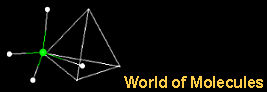
(hardest known mineral). Binding structure: 4 electrons in 3-dimensional
so-called sp3-orbitals
- graphite (one
of the softest substances). Binding structure: 3 electrons in
2-dimensional sp2-orbitals and 1 electron in s-orbitals.
- Covalent bound sp1 orbitals are of chemical interest
only.
Fullerite (fullerenes)
are nanometer-scale molecules. In the simple form 60 carbon atoms
form a graphitic layer which is bent to a 3-dimensional structure,
similar to a soccer ball.
Lamp black consists of small graphitic
areas. These areas are randomly distributed, so the whole structure is isotropic. So-called
'glassy carbon' is isotropic and as strong as glass. Unlike normal graphite, the
graphitic layers are not arranged like pages in a book, but are crumpled like
crumpled paper. Carbon fibers are similar to glassy carbon. Under special
treatment (stretching of organic fibers and carbonization) it is possible to arrange
the carbon planes in direction of the fiber. Perpendicular to the fiber axis there
is no orientation of the carbon planes. The result are fibers with a higher specific
strength than steel.
The element carbon occurs in all organic life and is the basis of organic
chemistry. This nonmetal also has the interesting chemical property
of being able to bond with itself and a wide variety of other elements,
forming nearly 10 million known compounds. When united with
oxygen it forms carbon dioxide which is absolutely vital to
plant growth. When united with hydrogen,
it forms various compounds called hydrocarbons which are essential
to industry in the form of fossil fuels. When combined with both
oxygen and hydrogen it can form many groups of compounds including
fatty acids, which are essential to life, and esters, which
give flavor to many fruits. The isotope carbon-14 is commonly used
in radioactive dating.
Notable characteristics
Carbon is a remarkable element for many reasons. Its different
forms include one of the softest (graphite) and one of the hardest
(diamond) substances known to man. Moreover, it has a great affinity
for bonding with other small atoms, including other carbon atoms,
and its small size makes it capable of forming multiple bonds. Because
of these properties, carbon is known to form nearly ten million
different compounds. Carbon compounds form the basis of all life
on Earth and the carbon-nitrogen cycle provides some of the energy
produced by the sun and other stars.
Carbon was not created in the big bang due to the fact that it
needs a triple collision of alpha particles (helium nuclei) to be
produced. The universe initially expanded and cooled too fast for
that to be possible. It is produced, however, in the interior of
stars in the horizontal branch, where stars transform a helium core
into carbon by means of the triple-alpha process.
Applications
The element carbon is a vital component of all known living systems,
and without it life as we know it could not exist (see carbon chauvinism).
The major economic use of carbon is in the form of hydrocarbons,
most notably the fossil fuels methane gas and crude oil. Crude oil
is used by the petrochemical industry to produce, amongst others,
petroleum, gasoline and kerosene, through a distillation process,
in so-called refineries. Crude oil forms the raw material for many
synthetic substances, many of which are collectively called plastics.
Other uses:
- The isotope 14C, discovered February 27th, 1940,
is used in radiocarbon dating.
- Some smoke detectors use tiny amounts of a radioactive isotope
of carbon as source of ionizing radiation (Most smoke detectors
of this type use an isotope of Americium)
- Graphite is combined with clays to form the 'lead' used in pencils.
- Diamond is used for decorative purposes, and also as drill bits
and other applications making use of its hardness.
- Carbon is added to iron to make steel.
- Carbon is used for control rods in nuclear reactors.
- Graphite carbon in a powdered, caked form is used as charcoal
for cooking, artwork and other uses.
- Charcoal pills are used in medicine in pill or powder form to
adsorb toxins or poisons from the digestive system.
The chemical and structural properties of fullerenes, in the form
of carbon nanotubes, has
promising potential uses in the nascent field of nanotechnology.
History
Carbon (Latin carbo meaning "charcoal") was discovered
in prehistory and was known to the ancients, who manufactured it
by burning organic material in insufficient oxygen (making charcoal).
Diamonds have long been considered rare and beautiful. The last-known
allotrope of carbon, fullerenes, were discovered as byproducts of
molecular beam experiments in the 1980's.
Allotropes
Four allotropes of carbon are known to exist: amorphous, graphite,
diamond and fullerenes. The discovery of a fifth form was announced
on March 22, 2004 [1] (http://www.nature.com/nsu/040322/040322-5.html).
In its amorphous form, carbon is essentially graphite but not held
in a crystalline macrostructure. It is, rather, present as a powder
which is the main constituent of substances such as charcoal and
lamp black (soot).
At normal pressures carbon takes the form of graphite, in which
each atom is bonded to three others in a plane composed of fused
hexagonal rings, just like those in aromatic hydrocarbons. The two
known forms of graphite, alpha (hexagonal) and beta (rhombohedral),
both have identical physical properties, except for their crystal
structure. Graphites that naturally occur have been found to contain
up to 30% of the beta form, when synthetically-produced graphite
only contains the alpha form. The alpha form can be converted to
the beta form through mechanical treatment and the beta form reverts
back to the alpha form when it is heated above 1000 °C.
Because of the delocalization of the pi-cloud, graphite conducts
electricity. The material is soft and the sheets, frequently separated
by other atoms, are held together only by van der Waals forces,
so easily slip past one another.
At very high pressures carbon has an allotrope called diamond,
in which each atom is bonded to four others. Diamond has the same
cubic structure as silicon and germanium and, thanks to the strength
of the carbon-carbon bonds, is together with the isoelectronic boron
nitride (BN) the hardest substance in terms of resistance to scratching.
The transition to graphite at room temperature is so slow as to
be unnoticeable. Under some conditions, carbon crystallizes as Lonsdaleite,
a form similar to diamond but hexagonal.
Fullerenes have a graphite-like structure, but instead of purely
hexagonal packing, also contain pentagons (or possibly heptagons)
of carbon atoms, which bend the sheet into spheres, ellipses or
cylinders. The properties of fullerenes (also called "buckyballs"
and "buckytubes") have not yet been fully analyzed. All the names
of fullerenes are after Buckminster Fuller, developer of the geodesic
dome, which mimics the structure of "buckyballs".
Occurrence
There are nearly ten million carbon compounds that are known to
science and many thousands of these are vital to life processes
and very economically important organic-based reactions. This element
is abundant in the sun, stars, comets, and in the atmospheres of
most planets. Some meteorites contain microscopic diamonds that
were formed when the solar system was still a protoplanetary disk.
In combination with other elements, carbon is found the earth's
atmosphere and dissolved in all bodies of water. With smaller amounts
of calcium, magnesium, and iron, it is a major component of very
large masses carbonate rock (limestone, dolomite, marble etc.).
When combined with hydrogen, carbon form coal, petroleum, and natural
gas which are called hydrocarbons.
Graphite is found in large quantities in New York and Texas, the
United States; Russia; Mexico; Greenland and India.
Natural diamonds occur in the mineral kimberlite found in ancient
volcanic "necks," or "pipes". Most diamond deposits are in Africa,
notably in South Africa, Namibia, Botswana, the Republic of the
Congo and Sierra Leone. There are also deposits in Canada, the Russian
Arctic, Brazil and in Northern and Western Australia.
Inorganic compounds
The most prominent oxide of carbon is carbon dioxide, CO2.
This is a minor component of the Earth's atmosphere, produced and
used by living things, and a common volatile elsewhere. In water
it forms trace amounts of carbonic acid, H2CO3,
but as most compounds with multiple single-bonded oxygens on a single
carbon it is unstable. Through this intermediate, though, resonance-stabilized
carbonate ions are produced. Some important minerals are carbonates,
notably calcite. Carbon disulfide, CS2, is similar.
The other oxides are carbon monoxide, CO, and the uncommon carbon
suboxide, C3O2. Carbon monoxide is formed
by incomplete combustion, and is a colorless, odorless gas. The
molecules each contain a triple bond and are fairly polar, resulting
in a tendency to bind permanently to hemoglobin molecules, so that
the gas is highly poisonous. Cyanide, CN-, has a similar structure
and behaves a lot like a halide ion; the nitride cyanogen, (CN)2,
is related.
With strong metals carbon forms either carbides, C-,
or acetylides, C22-; these are associated
with methane and acetylene, both incredibly pathetic acids. All
in all, with an electronegativity of 2.5, carbon prefers to form
covalent bonds. A few carbides are covalent lattices, like carborundum,
SiC, which resembles diamond.
Carbon
chainsIt´s the atomic structure of hydrocarbons in which a series of carbon
atoms, saturated by hydrogen atoms, form a chain. Volatile oils have shorter chains.
Fats have longer chain lengths, and waxes have extremely long chains. Carbon
cycle
The continuous process of combining and releasing carbon and oxygen
thereby storing and emitting heat and energy. Catabolism + anabolism
= metabolism. See carbon cycle.
Isotopes
In 1961 the International Union of Pure and Applied Chemistry adopted
the isotope carbon-12 for basis for atomic weights.
- Carbon-14 is a radioisotope with a half-life of 5715 years and
has been used extensively for radiocarbon dating wood, archaeological
sites and specimens.
Carbon has two stable, naturally-occurring isotopes: C-12 (98.89%)
and C-13 (1.11%). Ratios of these isotopes are reported in ?
relative to the standard VPDB (Vienna Pee Dee Belemnite from the
Peedee Formation of South Carolina). The dC-13 of the atmosphere
is -7?. During photosynthesis, the carbon that becomes fixed in
plant tissue is significantly depleted in C-13 relative to the atmosphere.
There is two mode distribution in the dC-13 values of terrestrial
plants resulting from differences in the photosynthetic reaction
used by the plant. Most terrestrial plants are C3 pathway plants
and have dC-13 values range from -24 to -34?. A second category
of plants (C4 pathway plants), composed of aquatic plants, desert
plants, salt marsh plants, and tropical grasses, have dC-13 values
that range from -6 to -19. An intermediate group (CAM plants) composed
of algae and lichens has dC-13 values range from -12 to -23?. The
dC-13 of plants and organisms can provide useful information about
sources of nutrients and food web relations.
Precautions
Compounds of carbon have a wide range of toxic action. Carbon monoxide
(CO), which is present in the exhaust of combustion engines, and
cyanide (CN-), which is sometimes in mining pollution,
are extremely toxic to mammals. Many other
carbon compounds are not toxic and are in fact absolutely essential
for life. Organic gases such as ethene (CH2=CH2),
ethyne (HCCH), and methane (CH4) are dangerously
explosive and flammable when mixed with air.
External links
|